

East Alton Wood River Community High School District #14’s latest Annual Financial Report shows that the district ended the 2025–26 fiscal year with substantial financial reserves, while also drawing on savings to support school operations and campus improvements.
The report covers July 1, 2025, through June 30, 2026. It provides a year-end accounting of the money the district received, what it spent, and what remained available for future needs. Independent accounting firm Scheffel Boyle reviewed the district’s financial statements.
For our families and taxpayers, the most important message is straightforward: EAWR has a financial cushion, but protecting that cushion requires continued attention to spending, future costs, and the pace of major projects.
Understanding the district’s savings
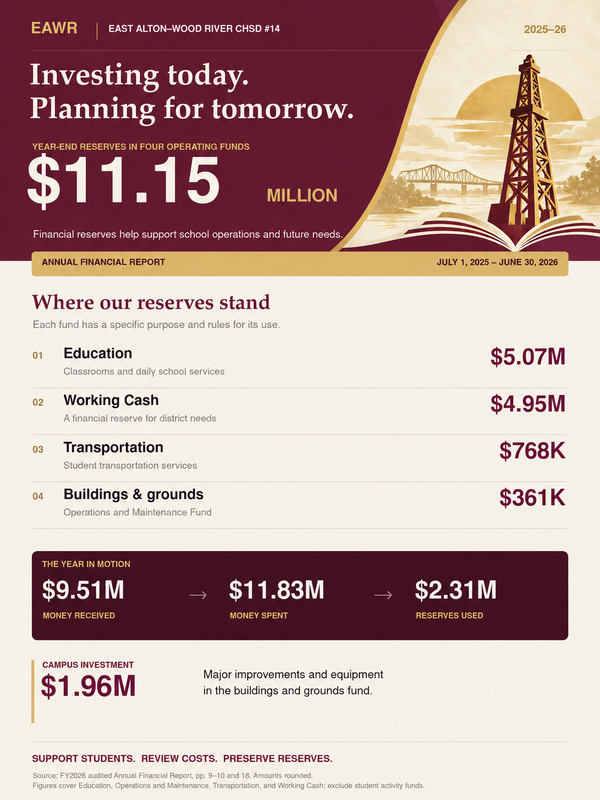
At the end of June, the district held approximately $11.15 million across its Education, Operations and Maintenance, Transportation, and Working Cash funds.
These funds serve different purposes. The Education Fund, which supports classroom instruction and many daily school services, ended the year with approximately $5.07 million. Working Cash, which serves as a financial reserve, held approximately $4.95 million.
The Transportation Fund ended with approximately $768,000, while Operations and Maintenance, which supports our buildings and grounds, ended with approximately $361,000.
These balances help the district pay bills between tax collections, handle unexpected expenses, and plan for larger needs. However, money in different school funds has specific purposes and rules governing its use. The combined balance should not be viewed as money freely available for any purchase.
What our financial rating means
The new report estimates EAWR’s financial profile score at 3.55 out of a possible 4.00, placing the district within Financial Recognition—the state’s highest financial rating category. The Illinois State Board of Education will determine the final score.
Think of this score as a financial checkup. It considers the district’s savings, spending compared with income, available cash, and borrowing capacity. Financial Recognition indicates an overall healthy financial position, while individual areas may still need attention.
The district’s financial history also shows meaningful progress. EAWR’s score was 1.55, in the Financial Watch category, in 2003 and 2004. The historical record shows Financial Recognition every year from 2017 through 2025, including several years with a perfect 4.00 score. Maintaining that progress requires continued financial discipline.
What “days of cash on hand” means
The report calculates 339 days of cash on hand—roughly 11 months.
In everyday terms, this estimates how long the district’s operating cash and investments could cover expenses at the average daily spending rate from the past year if no additional money came in. It measures the district’s ability to keep paying its bills through gaps between tax collections or delays in other funding.
Illinois awards its highest score on this measure to districts with at least 180 days of cash on hand. EAWR’s 339 days exceeds that benchmark.
This figure is a snapshot as of June 30. It changes as bills are paid and revenue arrives. It also includes reserves held in funds with different spending rules, so it should not be interpreted as 11 months of unrestricted spending money.
Spending and investment during the year
Across those four funds, the district received approximately $9.51 million and spent approximately $11.83 million. That means reserves declined by approximately $2.31 million during the year.
A major part of the spending involved investments in district facilities. Operations and Maintenance spending included approximately $1.96 million in major improvements and equipment purchases. These expenses help explain why that fund’s balance declined.
The Education Fund also spent approximately $783,000 more than it received during the year. That deserves continued attention because it supports the people, programs, and services students depend on each day.
Savings allow a district to address significant needs. They also have limits. Long-term planning must account for the difference between occasional major purchases and expenses that return every year.
What the independent audit found
The auditors concluded that the financial statements fairly presented the district’s finances under the reporting method prescribed by the Illinois State Board of Education.
Planning for the years ahead
Our responsibility is to support students today while maintaining the district’s ability to serve future generations. That means carefully reviewing ongoing expenses, prioritizing facility needs, and preserving adequate reserves.
Our community deserves a clear understanding of both the district’s resources and its challenges. We will continue using financial reports and the public budget process to guide decisions and explain how taxpayer dollars support EAWR students.