
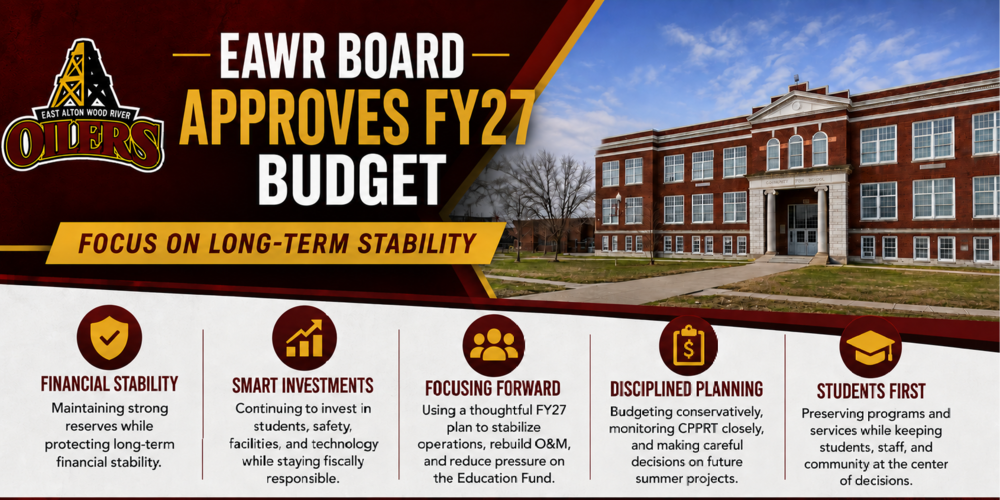
The East Alton Wood River Community High School District 14 Board of Education approved the district’s FY27 budget on September 8 following the required public hearing. The budget covers the school year and fiscal year running from July 1, 2026, through June 30, 2027.
The FY27 budget continues a financial plan the district has been working toward for several years: protect classroom and student services, complete needed facility and safety work, use reserves carefully for one-time expenses, and position the district for more stable spending in future years.
A Strong Financial Starting Point
EAWR entered FY27 with substantial reserves built up across its funds. The adopted budget projects approximately $13.3 million in receipts and other funding sources during FY27 and approximately $15.3 million in expenditures and other uses.
That difference is intentional.
The district expects to use approximately $1.94 million of accumulated reserves during FY27, much of it connected to planned facility work, safety improvements, equipment purchases and other one-time costs. These are expenses the district has planned for rather than new annual costs that will automatically continue every year.
One of the most important parts of the plan is a $1.4 million transfer from the Working Cash Fund to the Operations and Maintenance Fund. Working Cash serves much like a district savings account. The transfer does not send $1.4 million outside the district; it simply moves those dollars into the fund responsible for maintaining and improving district facilities.
After the transfer, the Working Cash Fund is still projected to end FY27 with approximately $3.77 million.
Protecting the Education Fund
The Education Fund pays for most of the district’s day-to-day educational operations, including instruction, student services and many employee costs.
EAWR is budgeting approximately $7.32 million in Education Fund revenue and $7.90 million in expenditures for FY27. The district expects to finish the year with approximately $4.47 million remaining in the Education Fund.
That would leave the Education Fund reserve at roughly 57% of a year’s expenditures, well above the district’s internal goal of maintaining at least 40%.
Protecting that reserve is a major part of the district’s long-term strategy.
Retirements Are Helping Control Personnel Costs
Personnel remains the largest expense for the district, but retirements and lower replacement costs are helping offset contractual salary increases.
Several longtime employees retired at the end of FY26, allowing the district to replace positions at lower salary levels. As a result, the district’s projected cost for currently filled positions is lower than the previous year even though employees received scheduled salary increases.
That is an important part of the financial plan because it allows EAWR to continue offering competitive wages while controlling the overall growth of payroll.
The district is also continuing to review each position and the fund that supports it so salary and benefit costs are assigned accurately rather than simply increasing department budgets from one year to the next.
Continuing to Invest in the Campus
FY27 will still be an active year for district facilities.
The budget includes funding for previously planned improvements, safety and security work, building projects and equipment. Operations and Maintenance spending reflects both previously planned work and approved changes to projects already underway.
Transportation equipment also includes the purchase of two Driver Education vehicles and a wheelchair-accessible van, providing the district with equipment that directly supports student programs and transportation needs.
The district’s plan, however, is not to maintain this level of capital spending indefinitely.
After the current project cycle, EAWR intends to slow major capital spending where possible, allowing reserves to begin rebuilding while continuing to address routine maintenance and true health, life and safety needs.
A More Disciplined Plan Going Forward
The district’s financial strategy for the next several years is straightforward.
EAWR intends to keep the Education Fund above its reserve target, rebuild Working Cash after the planned $1.4 million transfer, reduce major one-time project spending, closely monitor staffing costs, and continue taking advantage of investment earnings while interest rates remain favorable.
The district has budgeted approximately $400,000 in investment income for FY27 and will distribute that income among several funds rather than relying on it in only one area. At the same time, district officials recognize that interest rates can change, so investment earnings are not being treated as guaranteed long-term revenue.
The district will also continue using its real-time financial tracking throughout the year instead of waiting until the end of the fiscal year to determine how the budget performed.
Looking Beyond FY27
The FY27 budget is not designed around a single year.
The larger goal is to come out of the district’s recent period of major facility investment with buildings in better condition, strong educational reserves, manageable annual expenses and enough flexibility to respond when unexpected needs arise.
For EAWR, the FY27 budget represents the next step in that process: finish the work already planned, protect classroom resources, maintain healthy reserves and gradually rebuild the funds used to support the district’s recent improvements.